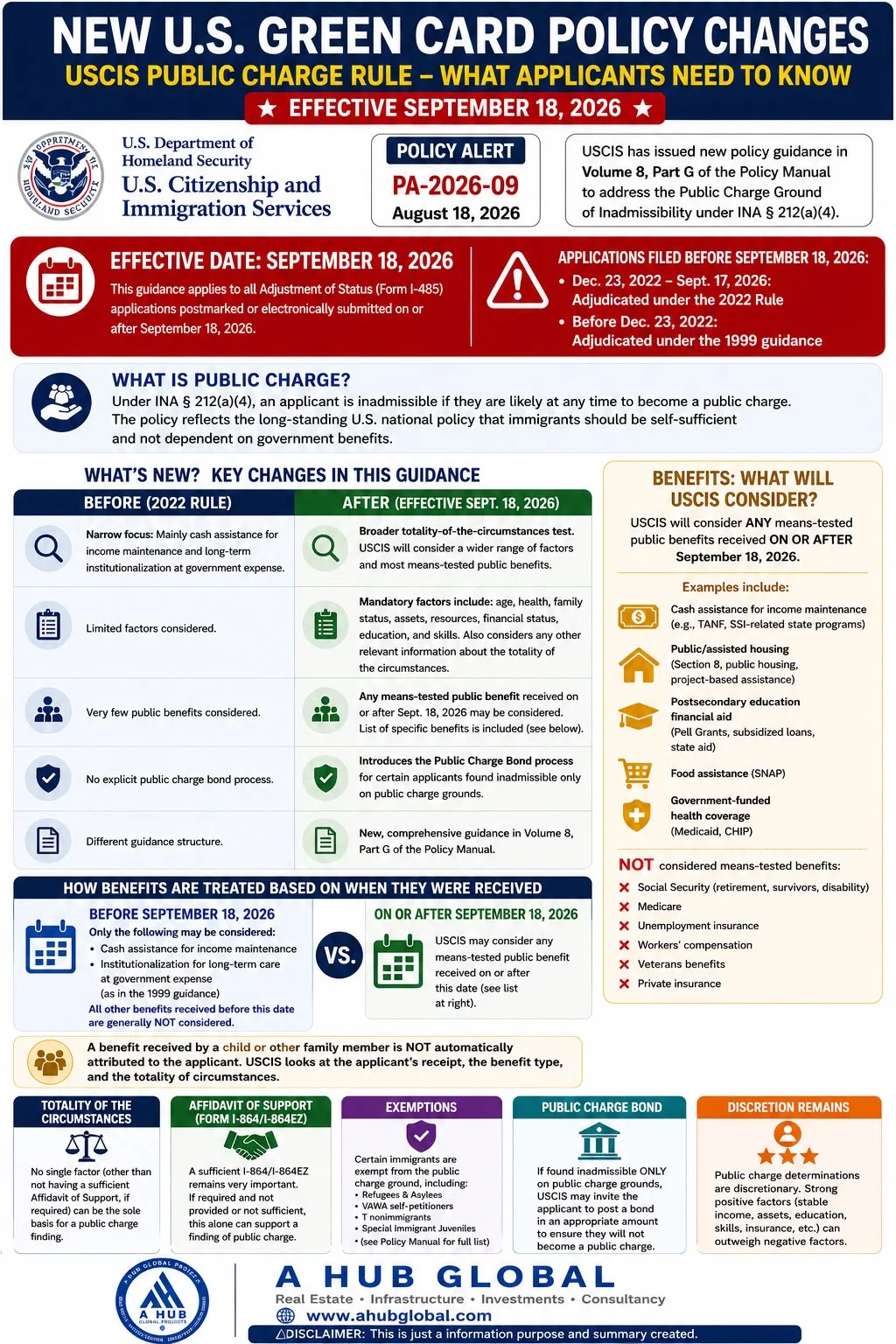
New U.S. green card policy changes:
USCIS public charge rule – what applicants need to know
Effective: September 18, 2026
Policy Alert PA-2026-09 | August 18, 2026
What is public charge?
Under INA § 212(a)(4), an applicant is inadmissible if they are likely at any time to become a public charge. The policy reflects the long-standing U.S. national policy that immigrants should be self-sufficient and not dependent on government benefits.
Key changes: before (2022 rule) vs. After (sept. 18, 2026)
2022 Rule
Before September 18, 2026
- Narrow focus on cash assistance
- Long-term institutionalization only
- Limited factors considered
- Very few benefits evaluated
- No public charge bond process
- Different guidance structure
Effective September 18
After September 18, 2026
- Broader totality-of-circumstances test
- Wider range of factors considered
- Mandatory factors: age, health, family status, assets, resources, financial status, education, skills
- Any means-tested benefits considered
- New Public Charge Bond process
- Volume 8, Part G guidance added
Benefits uscis will consider (on or after sept. 18, 2026)
- BENEFITS USCIS WILL CONSIDER (On or After Sept. 18, 2026)
- Public/assisted housing (Section 8, public housing, project-based assistance)
- Postsecondary education financial aid (Pell Grants, subsidized loans, state aid)
- Food assistance (SNAP)
- Government-funded health coverage (Medicaid, CHIP)
NOT Considered as Means-Tested Benefits
- Social Security (retirement, survivors, disability)
- Medicare
- Unemployment insurance
- Workers' compensation
- Veterans benefits
- Private insurance
How benefits are treated based on timing
BEFORE SEPTEMBER 18, 2026:
Only cash assistance for income maintenance and institutionalization for long-term care at government expense may be considered. All other benefits are generally NOT considered.
ON OR AFTER SEPTEMBER 18, 2026:
USCIS may consider ANY means-tested public benefit received on or after this date.
Important reminders
Family Benefits: A benefit received by a child or other family member is NOT automatically attributed to the applicant. USCIS looks at the applicant’s receipt, the benefit type, and the totality of circumstances.
Affidavit of Support: Form I-864/I-864EZ remains very important. If expired and not renewed, or if insufficient, this alone can support a finding of public charge.
Exemptions: Certain immigrants are exempt from public charge grounds, including:
- Refugees & Asylees
- VAWA self-petitioners
- T nonimmigrants
- U nonimmigrants
- Special immigrant juveniles
Public Charge Bond: If found inadmissible ONLY on public charge grounds, USCIS may invite applicants to post a bond to ensure they will not become a public charge.
Discretion Remains: Public charge determinations are discretionary. Strong positive factors (employment, education, income, assets, etc.) can outweigh negative factors.